Apple rebuilt Siri at WWDC and slipped one line into the newsroom post: it “collaborated with Google and the Gemini family of models” to build its next-generation Foundation Models. The company that designs its own silicon now sends Siri’s hardest reasoning to a custom Google model, reportedly for around $1B a year.
Tim Cook conceded onstage that Apple Intelligence “had not yet delivered on everything we promised.” That sentence is the whole story: even Apple decided licensing a frontier model beat catching up to one.
In today’s indie hacker news:
- 🍎 Apple routes the new Siri’s heavy reasoning to a Google Gemini model
- 💰 OpenAI filed a confidential IPO at an $852B reference valuation
- 🦟 A solo engineer’s AI laser turret cleared every mosquito in his house
- ⚡ Xiaomi clocked 1,000+ tps on a 1T model, with an asterisk
- 🔒 Signal says it will quit the UK before it breaks encryption
TOP STORIES
EVEN APPLE IS A GEMINI CUSTOMER NOW
🍎 Apple rebuilt Siri to route its heavy reasoning to a custom Google Gemini model

The story: The new architecture is three tiers. Easy requests stay on Apple’s on-device models, moderate ones go to Apple’s Private Cloud Compute, and anything that needs real reasoning gets handed to a custom Gemini model. Apple kept its own models for the first two tiers, so this is selective outsourcing, not a full surrender. TechCrunch has the full WWDC rundown, and MacRumors broke down the model stack. The Gemini deal itself isn’t new: Apple confirmed the choice to CNBC back in January, saying Google “provides the most capable foundation for Apple Foundation Models.”
The details:
- Siri is now “Siri AI,” a standalone app with multi-turn memory, on-screen awareness, and the ability to chain actions across apps.
- SiriKit is deprecated. You have roughly 2-3 years to migrate to App Intents, or your app goes functionally invisible to the new Siri.
- Bloomberg’s Mark Gurman reports the custom tier-3 model runs ~1.2T params, about 8x Apple’s own ~150B cloud model. That figure is Gurman’s, not Apple’s.
- iOS 27 ships around September. Siri AI launches in zero EU and zero China markets at release, on regulatory grounds.
Why builders care: Gemini is now the reasoning layer for Siri on roughly a billion iPhones, which makes it the default AI surface most mobile users will ever touch. The SiriKit clock started June 8: adopt App Intents inside the window or you vanish from a Siri that can now act across apps. It’s the same forcing function as the 32-bit cutoff. The quieter signal is about who builds frontier models at all: that work has now consolidated to a handful of labs, and the most valuable hardware company on earth just became a customer instead of a competitor.
Clone your voice once. Ship every video without re-recording. ElevenLabs Pro trains a voice clone in 30 minutes that sounds like you on every long-form, Short, and podcast you ship. We narrate every video on this newsletter with it. Beats hiring a VO artist on Fiverr or settling for a default TTS bot.
We get a cut if you sign up. Only added for tools we use ourselves.
THE IPO NOBODY GOT TO READ
💰 OpenAI filed a confidential draft S-1 at an $852B reference valuation
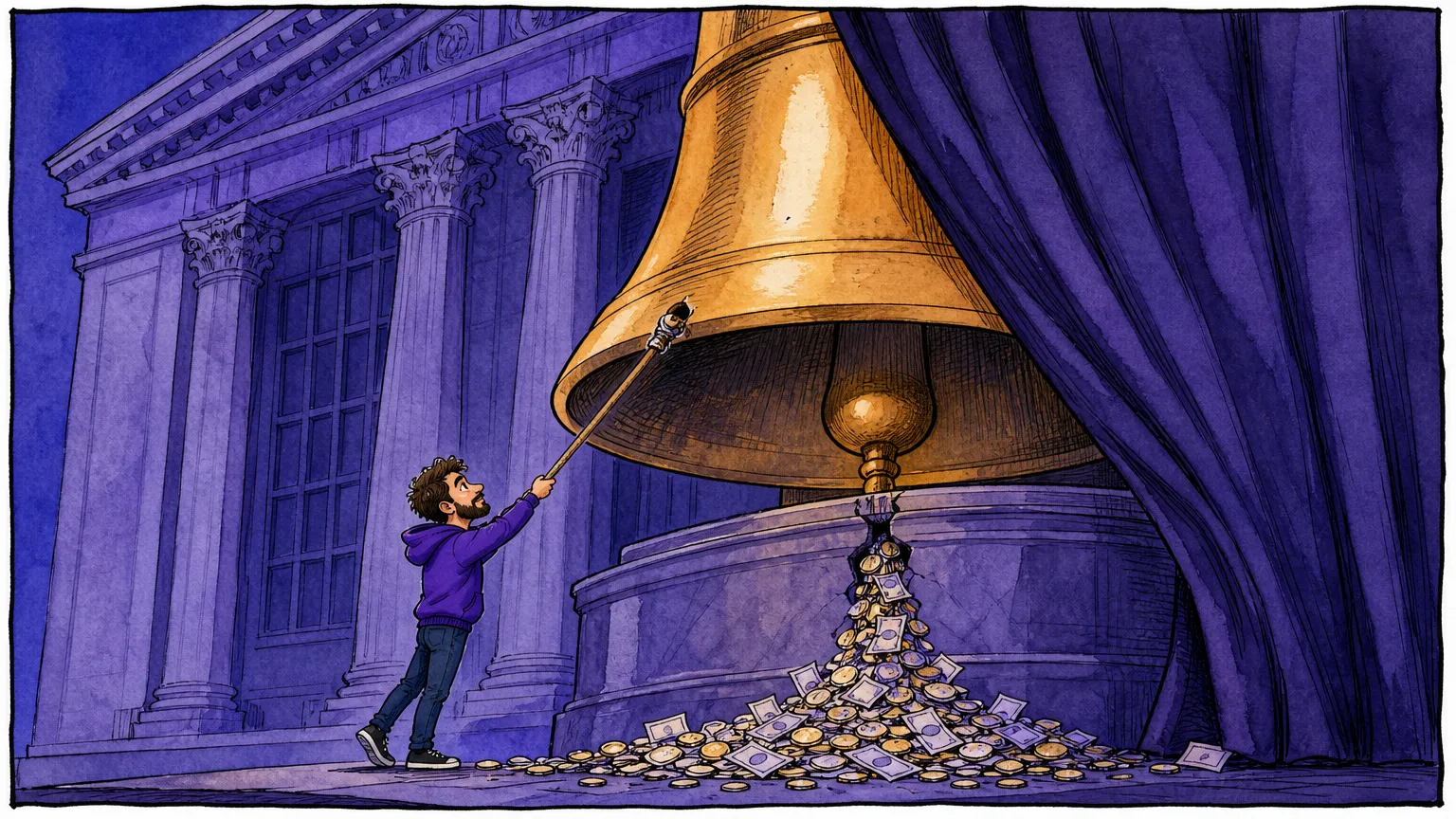
The story: On June 8, OpenAI submitted a confidential draft registration statement to the SEC. That’s the first formal step toward an IPO, not a committed one, and the financials stay sealed until OpenAI files a public amendment later. The company announced it itself, saying it expected the filing to leak anyway. Goldman Sachs and Morgan Stanley are leading the deal, and the $852B figure is the reference valuation carried over from its March private round, not a fresh IPO price.
The details:
- ChatGPT hit 900M weekly active users by the filing date, which is the growth number underwriting the whole valuation.
- “It may be a while because there are things we want to do that are likely easier as a private company,” OpenAI said. Timing is explicitly undecided. Analyst chatter guesses Q4, but that’s a guess.
- Microsoft holds ~26.79% fully diluted, around $228B at the $852B mark, with no board seat after October’s for-profit conversion to a Public Benefit Corporation.
- Ed Zitron’s newsletter reported a negative 122% operating margin in Q1, roughly $1.22 lost per revenue dollar. That figure is leaked, not in any SEC filing. Treat it as unconfirmed.
Why builders care: Once OpenAI is public, it faces quarterly earnings pressure for the first time, which structurally pushes it to fix API margins. Historically that means price cuts on commodity models to win volume, but also faster deprecation of old endpoints and tighter free tiers. When the draft eventually goes public, you finally get real numbers on how sustainable today’s API pricing actually is. If your business rides a single OpenAI endpoint, that leaked burn rate is a vendor-maturity signal. Keep a fallback provider warm.
FOUR MONTHS OF EVENINGS VS EVERY MOSQUITO
🦟 A solo CV engineer built an AI laser turret that cleared every mosquito in his home

The story: Steven Cheng, a Cambridge-based computer-vision engineer, spent four months training a custom deep-learning model on a mosquito dataset he shot himself with a DSLR and a zoom lens. He bolted it to an industrial rotary-stage gimbal with a laser and pointed it at his own home. Tom’s Hardware and TechSpot both traced it back to his original X thread. It’s a real build with embedded video, not an AI render, though the “every mosquito gone overnight” outcome is his own claim with no independent count and no public repo or parts list.
The details:
- A second wide-angle camera watches for humans and flammable material and kills the laser the instant anything overlaps.
- He shipped a v2 the same day with thermal imaging, harmonic drives, and a reinforced aluminum gimbal.
- “The dataset collection phase was brutal. The mosquitoes definitely fought back,” Cheng wrote, describing the bites he took to photograph them up close.
- Laser power, wavelength, and total cost are undisclosed. Ignore the “3ms” kill-time figure floating around. That belongs to Photon Matrix, a separate Chinese commercial product, not Cheng’s build.
Why builders care: This is a closed-loop physical-AI system built by one person with commodity gear: a DSLR, a GPU, an off-the-shelf rotary stage, and public deep-learning tooling. The distribution lesson is just as sharp. A single X thread with a short clip pulled ~67K views and triggered coverage from Tom’s Hardware, TechSpot, and Interesting Engineering with zero launch machinery. Showing the messy parts, the bites and the training runs, is what made it travel. “AI plus robotics weekend hack” stopped being a research-lab exclusive.
1,000 TOKENS A SECOND, READ THE FOOTNOTE
⚡ Xiaomi’s MiMo team says it hit 1,000+ tokens/sec on a 1T-param model
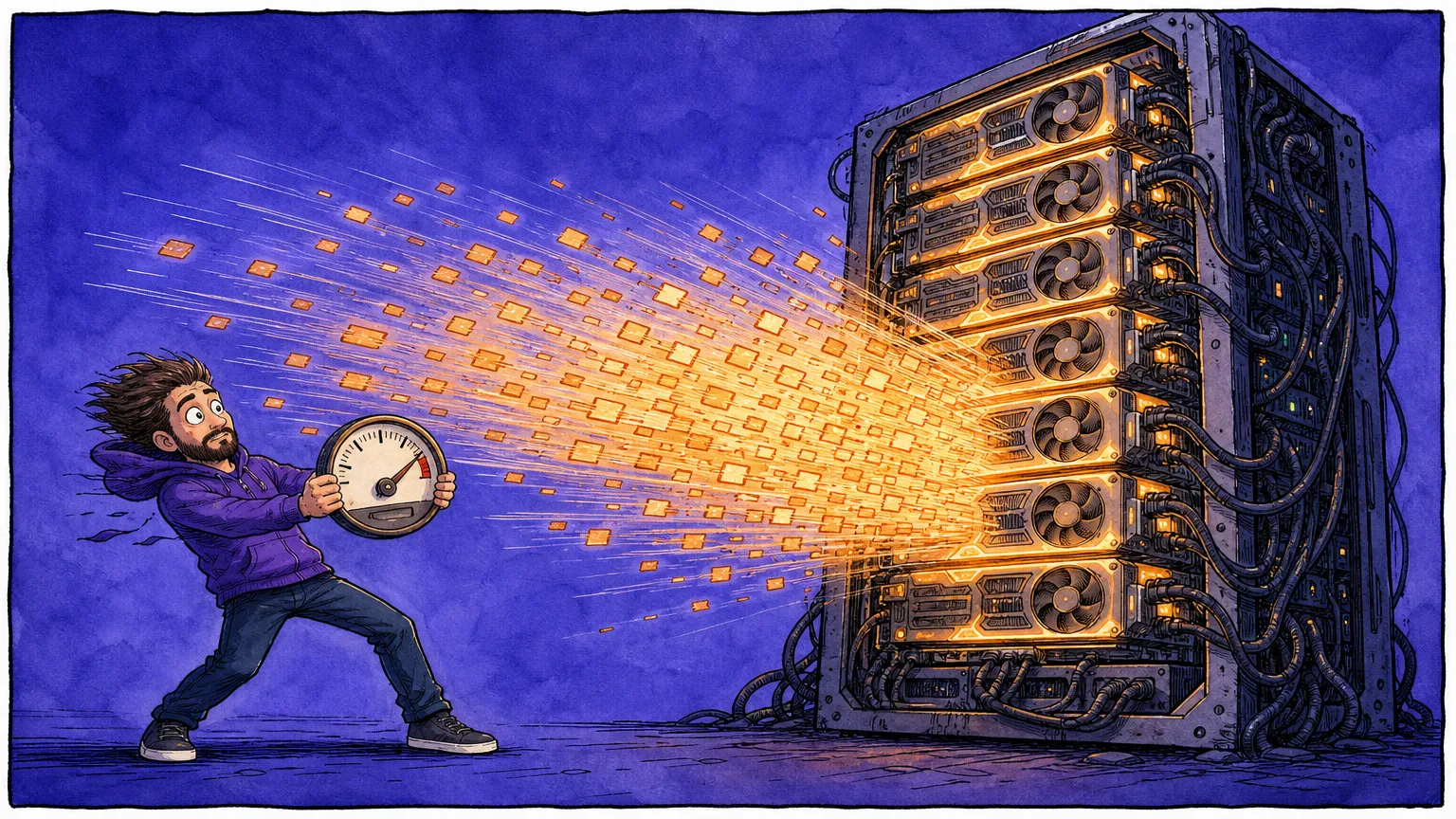
The story: Xiaomi’s MiMo team published a benchmark showing 1,000+ tokens/sec on MiMo-V2.5-Pro-UltraSpeed, a 1T-total MoE model with ~42B params active per token. Two corrections to the framing that’s making the rounds. First, that 1,000 tps is aggregate throughput across many batched concurrent requests on one node, not the single-stream speed any one user sees. Second, the “8 standard GPUs” are 8x NVIDIA B200, a roughly $2-3M box, not commodity hardware. The numbers are real; the headline just hides the fine print.
The details:
- The win is codesign: Xiaomi applied FP4 quantization-aware training only to the MoE expert layers, keeping attention and embeddings at higher precision so reasoning didn’t degrade.
- The serving engine is TileRT, a custom open-source runtime, not vLLM or SGLang. Its own baselines on the same node show ~500 tps on GLM-5 and ~600 tps on DeepSeek-V3.2.
- Only ~4% of the model fires per token, so the active compute looks more like a mid-size dense model. That’s how MoE pulls high throughput.
- Weights are on HuggingFace and TileRT is public, so the technique is reproducible in principle. B200s are export-controlled to China, and Xiaomi didn’t say where the cluster ran.
Why builders care: The reusable lesson is the codesign trick, not the headline number. Quantizing only the layers that tolerate it is what freed the bandwidth, and Xiaomi shipped both the recipe and the engine in the open, so you can verify the gains instead of trusting them. For agentic workloads in tight eval-iterate loops, that kind of cheap throughput is the whole game. Just benchmark per-stream latency at your own concurrency before you budget for a Blackwell node, because the vendor number assumes a full batch you may never run.
TRENDING TODAY
🔒 Signal says it will leave the UK before it breaks encryption - Signal’s June 8 statement, “Surveillance Is Not Safety,” opposes the UK’s latest push for encryption backdoors under the Online Safety Act, which lets the Home Secretary issue secret orders to compel removal of encryption. President Meredith Whittaker has been blunt: Signal would walk rather than undermine the trust people place in it. The precedent looms large. Apple already disabled end-to-end encryption for UK iCloud users in early 2025 after a similar notice. Every privacy-product builder operating in the UK faces the same comply-or-exit fork.
📉 Morningstar calls the SpaceX IPO roughly 2x overvalued - Analyst Nicolas Owens pegs SpaceX’s fair value at $63/share ($780B) against an IPO price near $135 ($1.75T), a 53% discount. It opened the same week OpenAI filed its own draft. Two of the most hyped tech listings ever, landing together, both flagged as priced for perfection. When top analysts call the marquee deals double their worth, that’s the froth climate every startup will raise into next.
🎯 The first-customer grind owns the founder subreddits today - A cluster of high-ranking posts across r/SaaS, r/startups, and r/SideProject all circle the same nerve: getting from zero to first paying users. The throughline in the comments is that the product rarely needs fixing, the conversion mechanics do. The product-problem most founders chase is usually a distribution problem wearing a costume.
FIRST DOLLAR
🤝 A founder landed 5 paying customers by selling to other SaaS founders - The tactic: build a list of ~20 recently-funded founders (searched “raised pre-seed/seed” on LinkedIn, cleaned into a table with ChatGPT), then send tiny personalized DMs referencing their raise. Result was 5 paying customers plus 2 design partners in about three weeks, roughly 25% conversion off 20 targets. The tightest ICP is peers feeling the exact pain you solve.
📈 A solo dev took an app from $60 to $300 MRR by changing only onboarding and the paywall - Stuck at $60 for months while shipping features, the founder of a foreign-words learning app changed two things: more personal onboarding and a 3-day trial that let users try the main flow before paying. Trial conversion went 2.5% to 5%, revenue hit ~$300 in the following week. It’s a one-week snapshot, and a top commenter notes trial cohorts can front-load, so retention is still unproven.
STACK OF THE DAY
🔍 Leadmint - A free Android app that surfaces Reddit leads from your competitors’ keywords, then drafts AI replies you can fire off. It does keyword alerts, a 30-day save-and-schedule queue, and an analytics dashboard, with no artificial cap on keywords or subreddits in the base app. It ties straight into today’s first-customer theme: instead of broadcasting into the void, you reach people already complaining about the exact thing you fix. Genuinely free today, though the comments hint at a future upsell.
Not sponsored. We just feature tools builders would actually use.
BOOKMARKED TODAY
🛸 “Everyone can build apps now, but almost nobody has distribution” - @levelsio’s most-saved post today (526 bookmarks) relays a friend’s report from an indie-hacker meetup: nearly everyone is building elaborate AI code-gen “spaceships” that generate landing pages and SaaS and dashboards, but almost none of them have money or traffic, and nobody knows where to get either. The build problem is solved. The reach problem isn’t.
🚀 Pushscroll claims 1M+ users and $100K MRR on a do-pushups-before-scrolling app - @skyirezumi is dangling a growth thread for a consumer app that makes you do pushups to unlock your feed. The scale checks out: 16,000+ App Store ratings at 4.7 stars, live on both stores. The $100K MRR is the founder’s own claim, not Stripe-verified, but it’s arithmetically plausible at those prices.
🔑 The r/microsaas thread behind today’s free Reddit-lead finder - The discussion behind today’s Stack pick, with the founder fielding questions on how the keyword matching and reply drafting actually work. Worth a read for the build details before you install.
Ship to one country, QA it from another. Geo-fenced Stripe checkouts, region-gated APIs, feature flags that only fire in EU. NordVPN's 6,400+ exit nodes across 110+ countries let you test a US-only paywall from EU or hit a EU-only checkout from SF. Bonus: free Meshnet for SSH across your devices.
We get a cut if you sign up. Only added for tools we use ourselves.
Curated by AI, built by a human. Reply with what you’d change. Want this in your inbox daily? Subscribe here.