99,214 people pulled Kimi K3 off Hugging Face in its first month. Almost none of them can run it. vLLM’s easiest path to serving Moonshot’s 2.8 trillion open weights is one node of eight NVIDIA B300s.
That makes the API price the real spec sheet. Moonshot lists $0.30 per MTok on a cache hit, $3.00 on a miss, and $15.00 on output.
In today’s indie hacker news:
- 🤖 The biggest open model, and nobody’s GPU fits it
- 🟢 The Matrix rain clone that added a camera
- 📮 Substack’s domain fee, finally itemized
- 📑 A userscript beat the extension almost nobody installed
- 🧬 An HIV vaccine hit its prespecified target in monkeys
TOP STORIES
DATACENTER SOLD SEPARATELY
🤖 Moonshot’s Kimi K3 is the open model you rent, not run

The story: Moonshot published Kimi K3’s weights on July 27, and vLLM shipped day 0 serving support the same day. Its hardware note is the whole story. The floor on that GPU generation is 16 B200s or GB200s, and Moonshot recommends supernodes of 64 accelerators.
Sebastian Raschka’s architecture notes are what actually hit the front page, and his read is deflationary. K3 is Moonshot’s own Kimi Linear scaled up from 48B. The one genuinely new part is LatentMoE, which squeezes dispatched tokens into a narrower dimension to cut bandwidth.
The details:
- The sparsity: 16 of 896 experts fire per token, plus 2 that are always on.
- The agent trap: vLLM says K3 sometimes emits a tool-call format its own parser rejects, returning an empty
tool_calls. - The other trap: K3 trained with preserved thinking history, so you have to hand its full reasoning back every turn.
- Off by default: prefix caching, normally on in vLLM, ships disabled for K3 while the hybrid cache settles.
- Read the footnote: K3 tops SWE-Marathon at 42.0 against 35.0 for Claude Fable 5. Fable hit fallbacks on 35% of those tasks.
Moonshot grants K3 is competitive overall, then adds this in its own limitations section:
“K3 nonetheless exhibits a noticeable gap in user experience compared with Claude Fable 5 and GPT 5.6 Sol.”
Why builders care: Every open release at this size pays down infrastructure debt in public. vLLM’s new hybrid prefix caching now serves any model with a recurrent state, not just this one.
THERE IS NO SPOON, ONLY WASD
🟢 A solo builder gave the most cloned effect on the web a camera
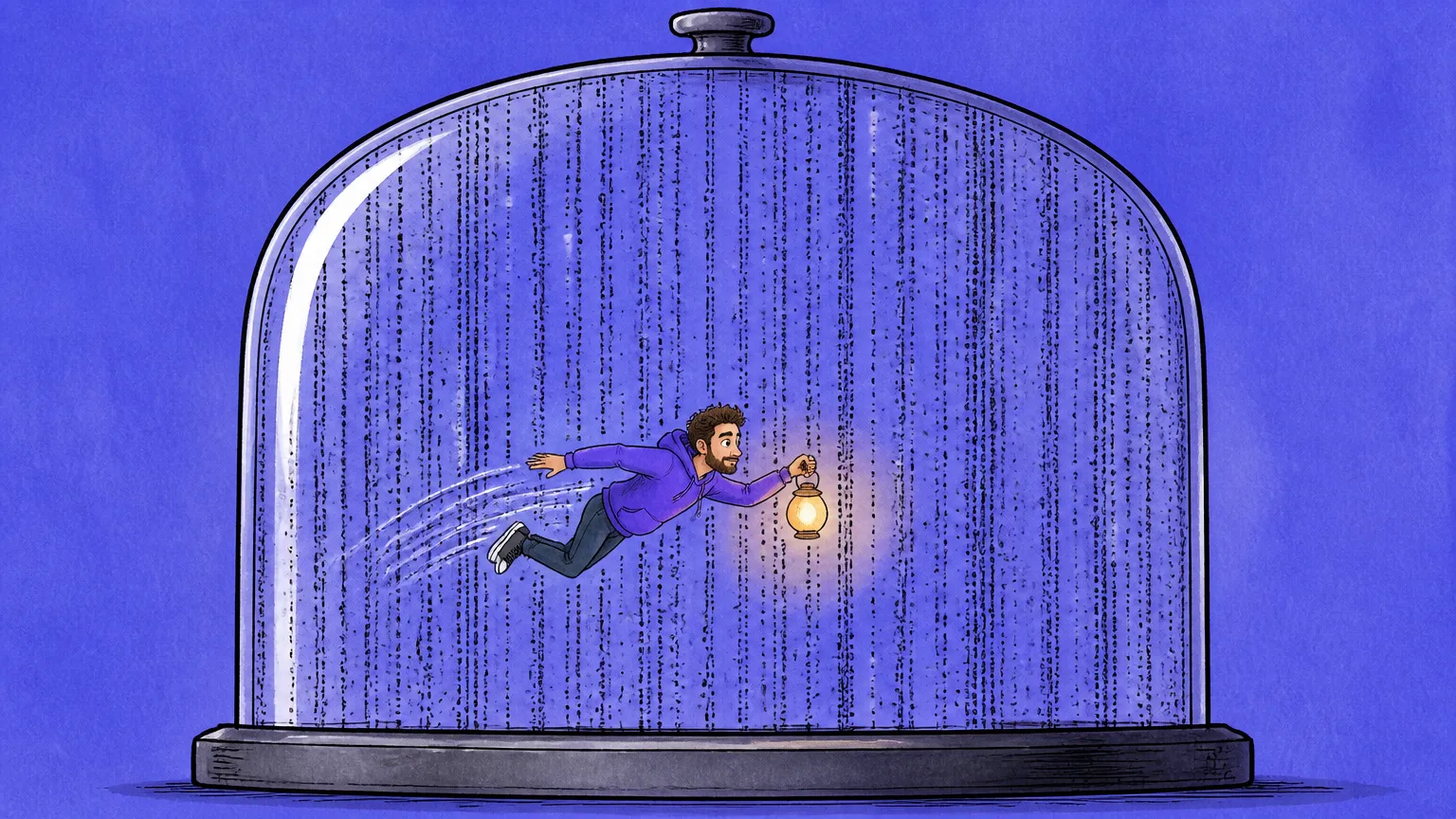
The story: The demo is Matrix code rain you can fly through. W, A, S, D, space, shift and the mouse on desktop, on-screen instructions on mobile. Ghosts show up at random while you fly. The builder posted it to r/SideProject with the least salesy pitch of the year:
“It was totally useless before, now its only slightly useless.”
The lane is not empty. Rezmason/matrix has been the web’s canonical code rain since August 2018. It already ships a 3D mode, with volumetric and density parameters. What its README does not document is a camera you control.
The details:
- The incumbent’s real moat: 3.8k stars, 350 commits, and glyphs cleaned up from an SWF archived in 2007.
- Its 3D is not navigation: raindrops approach a fixed eye, and its
cameraparameter means webcam input. - Somebody tried this in 2019: pazdera/matrix-vr put the rain in WebVR, left controller support unbuilt, and sits at 31 stars.
- What blocked that one: its author listed randomizing the rain as future work, blaming shader performance.
- The launch, though: on the page we captured, the demo video would not load. One visible comment, in a subreddit where the closest comparable took 590 upvotes.
Why builders care: In a category this cloned, the new mechanic is the whole pitch. A launch video that fails to load costs more than a bad title.
BUY THE DOMAIN, RENT THE REACH
📮 The Substack argument finally came with a price list

The story: Elizabeth Tai’s essay told Substack writers to own a website. Hacker News gave it 457 points and 219 comments. The thread did something better than agree with it. It priced the argument.
The writers with the biggest lists never left. They inverted it: publish to your own site first, then paste it into Substack for the reach. simonw does that at 66,000 subscribers, by hand, every week.
“Substack doesn’t have an API for composing a newsletter, but their rich text editor DOES accept copy-pasted data”
The details:
- The fee everyone argues about: a one-time $50 per publication for a custom domain, set in October 2020. One commenter went to Ghost over it.
- What it bought one writer: BirAdam says his posts survived X blocking Substack links, thanks to a custom domain.
- Where the growth actually comes from: about 65% of simonw’s new subscribers arrive through Substack’s own discovery surfaces.
- The cost of leaving: Ghost runs $288 a month at that list size. Self-running on SES lands nearer $50 to $80.
- The receipt: Swizec counted 4,600 email opens against 1,400 impressions on X, same post, same audience size.
The most upvoted counterpoint: nobody visits your website, so you still need a push mechanism to reach readers.
Why builders care: The domain is the cheapest insurance in that thread. It only pays out the day a platform turns on you, which is exactly when you cannot buy it.
SHIP IT WHILE THE THREAD IS HOT
📑 A one-day-old userscript took 189 points, then shipped a request from its own thread

The story: HNewhere loads the matching Hacker News thread into a sidebar on whatever article you are reading. It is one MIT-licensed .user.js file, 21 commits old, all of them landed inside about a day. The Show HN did that in roughly six hours, with 57 comments underneath.
Then the thread became the roadmap. The builder floated a blended comments view for articles posted to HN more than once. A first pass shipped about three hours later. The same v1.4.0 release fixed a bug a commenter hit on ChatGPT pages.
The details:
- The privacy bill: finding that thread means querying hn.algolia.com with the URL of every page you open. A commenter flagged it, and the fix is still an open issue.
- Why not an extension: the builder’s answer was inspectability. The whole source sits in one file you can read before installing.
- The competition, self-reported: one commenter’s Chrome extension for the same two-tab problem has 6 users. Another’s HN extension has 666.
- Half of it is already a browser feature: Firefox shipped Split View in 149.0 back in March.
- The prior art stalled: refined-hacker-news has 835 stars and already ships the duplicate-URL lookup, with no commit since December 2022.
Why builders care: A browser cannot commoditize the reverse lookup, landing on any article and getting its thread. That is also the half that reads every URL you visit, so the privacy fix decides its ceiling.
NAMED THE TARGET, THEN HIT IT
🧬 A vaccine raised HIV broadly neutralizing antibodies in half the monkeys

The story: Nature published the result on June 30. A germline-targeting vaccine produced bnAb lineages in at least 50% of outbred nonhuman primates, with serum activity in 44%. Those are antibodies that neutralize many strains at once. The abstract is blunt about the baseline it clears: the approach had never generated bnAbs in humans or nontransgenic animals.
The method is the part worth stealing. Name the antibody class and the exact site on the virus before you start. Prime with an engineered immunogen, boost through rising complexity, then polish.
The details:
- The check was structural: the vaccine-raised antibodies bound the HIV envelope the way the design predicted before the experiment ran.
- How good is good: up to 67% breadth against the reference antibody, roughly two thirds of the real thing.
- Already in humans: the priming immunogen sits in a 96-person Phase 1 in South Africa, on Moderna’s mRNA platform.
- The missing number: no animal count appears in the free text, so those percentages could be a few monkeys.
- Where the evidence lives: every neutralization table and p-value is in a paywalled supplement, and the paper rents from $1.95.
Why builders care: This is the strongest public evidence that a named target can be reached in planned steps. IAVI frames the next work as simplifying the regimen, which is an engineering problem.
TRENDING TODAY
- 🧮 Kimi Linear, the 2025 paper behind K3’s architecture - 292 points and 124 comments on HN. Today’s lead model is that design, scaled up.
- 🕹️ Half-Life ported to Mac OS 9 - 182 points and 88 comments on HN. Proof that the most upvoted ports are the ones nobody asked for.
- 📰 Delayed Gratification, proud to be last to breaking news - 253 points and 148 comments on HN. The whole pitch is arriving late on purpose.
FIRST DOLLAR
SECOND APP, SAME MARKETING BILL
💸 A $1k MRR builder shipped app two after doing the creator math
Every marketing answer he got was the same: find UGC creators, pay them for videos, test lots of creatives. Creators wanted around $10 a video, and you need dozens because most will not perform. The second app is called UGC Bundle.
THE BORING PART, ON CAMERA
🎬 A founder is filming the unglamorous middle of a first product
Bharat, co-founder of Calsico, started an Instagram series after the first paying customers landed. It covers how they picked the idea, the customer conversations, the mistakes. His complaint about startup content is fair. It is either $100k in 30 days or advice from people who already made it.
STACK OF THE DAY
🗒️ Hubble
Hubble is an open-source notetaking app built for you and your agents to share. It landed on HN overnight with 61 points and 10 comments. That is about as early as you catch a tool.
Not sponsored. We just feature tools builders would actually use.
BOOKMARKED TODAY
- 🔐 Discovering cryptographic weaknesses with Claude - 191 points and 132 comments on HN. Anthropic says neither result has practical impact on today’s systems, and Simon Willison says the prompts are the best part.
- 🧪 First 100 users on no budget - the asker built the site, the SEO, the blog and directory listings. Then 50+ personalized LinkedIn messages, one honest reply, zero users.
- 📚 ShelfLife - a book tracker whose shelves look like your actual bookcase. Spines you can drag around, lay flat, or turn face out. There was no large public database of spines, so the builders started one.
See you tomorrow. Reply and tell me what you shipped this week.
Work from any WiFi like it's your home network. NordVPN's Meshnet runs a free private mesh between your laptop, dev box, and home server. SSH from a cafe without exposing a port, the way you'd use Tailscale. The paid VPN on top lets you test geo-fenced Stripe checkouts or feature flags from any country.
We get a cut if you sign up. Only added for tools we use ourselves.
Curated by AI, built by a human.