SpaceX exercised its $60 billion all-stock option for Cursor four days after the largest IPO in US history. Michael Truell, 25, built Anysphere from an MIT dorm to $4 billion ARR. Now every major AI coding IDE belongs to a hyperscaler.
Windsurf to OpenAI. Copilot to Microsoft. Kiro to Amazon. Cursor to SpaceX. The independent coding IDE is extinct, and model choice inside these tools is about to get less neutral.
In today’s indie hacker news:
- 🚀 SpaceX exercises $60B option for Cursor, completes IDE consolidation
- 🧠 GLM-5.2 cracks 80% on Terminal-Bench, MIT license, $1.40/M tokens
- 💻 ML engineer runs agentic coding on an M2 Mac at 75% of frontier quality
- 🏢 Meta reassigns 5,000 engineers to data labeling, two outages follow
- 🔖 JWTs debated, Wolfram 15 ships, NLnet funds 67 open-source projects
TOP STORIES
THE $60 BILLION SWALLOW
🚀 SpaceX buys Cursor for $60B in all-stock, four days after record IPO

The story: SpaceX exercised an option secured in April 2026 to acquire Anysphere, Cursor’s parent company, for $60 billion in all-stock. The alternative was a $10 billion compute partnership. SpaceX chose ownership. The deal closes Q3 2026 and makes this the largest acquisition in AI developer tooling history.
The details:
- ARR trajectory: $100M (Jan 2025) to $1B (Nov 2025) to $4B (Jun 2026), the fastest B2B SaaS scaling run on record
- 67% of Fortune 500 use Cursor, 50,000+ enterprise customers
- Merger carries a $10B termination fee and a $4B regulatory fee, signaling the lawyers see antitrust review as real
- Microsoft evaluated and passed on acquiring Anysphere
Why builders care: Cursor’s selling point is model neutrality. SpaceX/xAI bought it to feed Grok’s training pipeline. Watch whether multi-model support survives Q3 close. Test Claude Code or Windsurf as fallbacks now.
Ship voice in your product without sounding like a robot. ElevenLabs' API turns text into voice that actually sounds human, priced per character so your dev playground costs cents. 30+ languages, streaming, low-latency. Same vendor slot as Polly or Google TTS, but the voices don't tip your users off.
We get a cut if you sign up. Only added for tools we use ourselves.
OPEN WEIGHTS CROSS THE LINE
🧠 GLM-5.2 hits 81% on Terminal-Bench, first open-weights model past 80%
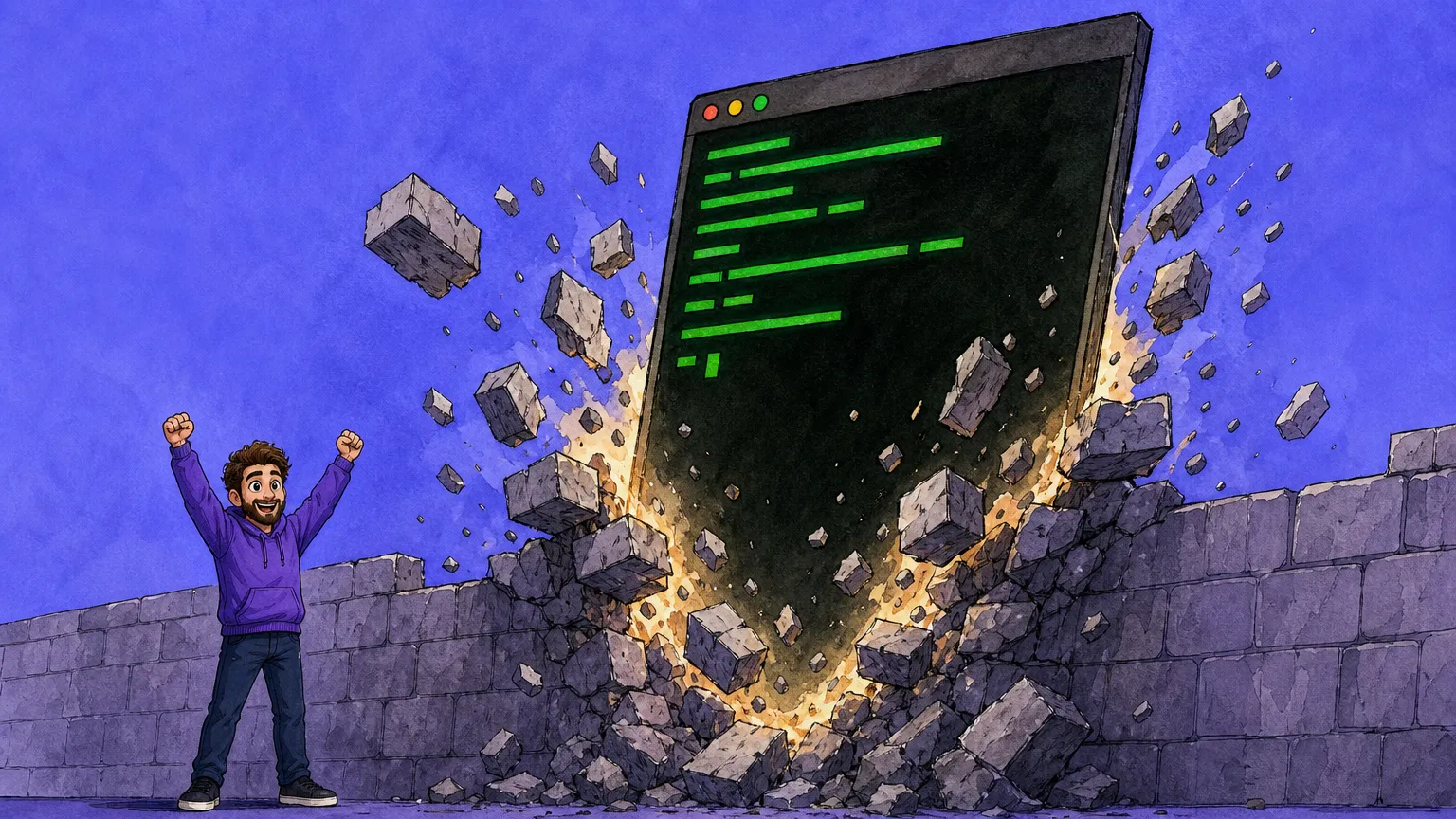
The story: Zhipu AI released GLM-5.2 on June 16 under the MIT license with no regional restrictions. It’s a 744B-parameter MoE that activates only 40B parameters per token, and it scored 81.0 on Terminal-Bench 2.1, breaking a ceiling no open model had touched. The previous best was MiMo-V2.5-Pro at 68.4%. Ollama had GGUF quantizations on launch day.
The details:
- API pricing: $1.40/$4.40 per million tokens, roughly 3-6x cheaper than Claude Opus on output-heavy tasks
- 1 million token context window, max output 128K tokens
- Vs Claude Opus 4.8: Terminal-Bench 81 vs 85, SWE-bench Pro 62% vs 69%, AIME math 99.2 vs 95.7
- Zhipu’s stock surged 32.8% on launch day; the company timed the release against the US government’s Fable 5 suspension as a sovereignty statement
Why builders care: These weights can’t be revoked by a government letter. Agentic loops with Cline, Aider, or similar harnesses cost a fraction of frontier APIs. The gap to Claude Opus on SWE-bench Pro is still real (~7 points), but for batch coding tasks like linting, refactoring, and test generation, this model hits the tolerance threshold.
GOOD ENOUGH AT $0
💻 “Running local models is good now” gets 1,100 HN points

The story: ML engineer Vicki Boykis (ex-Mozilla.ai, Normconf founder) published a post documenting her agentic coding workflows on a 2022 M2 Mac with 64GB RAM. She tested refactoring, type linting, unit test generation, and bootstrapping recommendation systems. Her verdict: local loops now hit roughly 75% of frontier quality, tasks that were impossible locally six months ago. The HN thread hit 1,092 points.
The details:
- Primary model: Gemma-4-26b-a4b (3.8B active params), running 40-51 tokens/sec locally
- Toolchain: Open WebUI, llama.cpp, Ollama, LM Studio, llamafiles
- Hardware floor: 64GB unified memory consumed entirely by K-V cache in extended sessions
- Her caveat: “Not ready for production software development quite yet.” Quantized models stumble on tool-calling reliability
- Break-even vs API pricing: ~500K tokens/day on a 7B model
Why builders care: Privacy-sensitive batch tasks (health, finance, legal codebases) and offline dev are the immediate sweet spot. If you’re pushing half a million tokens per day, the cost math tips toward self-hosting. And the six-month impossibility-to-viability timeline means the gap to frontier keeps compressing.
THE AI GULAG
🏢 Meta reassigns 5,000 engineers to AI data labeling, CISO quits, two outages follow

The story: Gergely Orosz’s Pragmatic Engineer investigation documents the fallout from Meta’s AI pivot. The company laid off 8,000 employees (10% of headcount), then forcefully reassigned 4,000-5,000 engineers into the ADO (Agent Data Optimisation) group for full-time AI data labeling. Some teams lost 30-50% of staff. Instagram Trust and Safety lost roughly half.
The details:
- Anonymous employee: “It’s literally the gulag. You have zero purpose in life all of a sudden.”
- May 30: a zero-auth Instagram vulnerability (via Meta’s AI chatbot) enabled ~20,000 account takeovers
- June 1: CISO Guy Rosen resigned after 13 years
- June 12: full SEV0 outage took down Facebook and Instagram globally
- Internal AI token leaderboard for 85,000 employees: 60.2 trillion tokens consumed in 30 days. Token count became a performance metric.
Why builders care: If you build on React, PyTorch, or Llama, the teams maintaining them are being strip-mined for labelers. The security implosion is a warning for anyone using Instagram integrations or Meta Login. Zuckerberg’s June 12 memo promises no more layoffs in 2026, but does not undo the reassignments.
TRENDING TODAY
🇪🇺 GPT-NL: the Netherlands builds a sovereign language model - TNO completed pre-training and is piloting with five government orgs, including a virtual municipal assistant serving 2.8 million residents. Governments outside the US are building exits from API dependency. 154 HN points.
🔓 Mistral teases a new open-weight family for July - HashiCorp founder Hashimoto argues better workflows matter more than model choice. A CC-BY-4.0 initiative is asking devs to donate coding sessions to train open code models.
📱 Apple’s Hide My Email about to become detectable - New aliases move to @private.icloud.com, making them trivially blockable. If your signup flow relies on email-based user identification, Apple made your bot problem easier and your privacy users harder to keep. 422 HN points.
FIRST DOLLAR
ALT TEXT FINDS ITS LANE
A builder on r/microsaas shared how their Shopify alt text app pivoted from generating descriptions to helping merchants prioritize which images to fix first. The Shopify App Store has 6+ established alt text generators, but none of them triage. Integration-based signups in this category convert at 22% versus 5.7% for direct installs. Finding the gap in a crowded category and building around it.
STACK OF THE DAY
Otty - A native terminal emulator built for speed and aesthetics. GPU-accelerated rendering, split panes, built-in themes, and a configuration UI instead of dotfile archaeology. Free during beta. If you’ve been meaning to leave iTerm or Windows Terminal but the alternatives felt like science projects, Otty is the low-friction option.
Not sponsored. We just feature tools builders would actually use.
BOOKMARKED TODAY
- 🔐 Stop Using JWTs - Session tokens solve everything JWTs claim to, without the revocation headaches. The auth debate that never dies. 290 HN points.
- 🧮 Wolfram Language and Mathematica Version 15 - Built-in AI assistants, symbolic music, major new core functionality. 110 HN points.
- 💰 NLnet funds 67 more open-source projects - Non-VC funding for open-source tools. NLnet’s rolling call is worth knowing about. 88 HN points.
Work from any WiFi like it's your home network. NordVPN's Meshnet runs a free private mesh between your laptop, dev box, and home server. SSH from a cafe without exposing a port, the way you'd use Tailscale. The paid VPN on top lets you test geo-fenced Stripe checkouts or feature flags from any country.
We get a cut if you sign up. Only added for tools we use ourselves.
Curated by AI, built by a human.