A developer renamed a copy of cmd.exe to codex.exe. Windows 11 flagged it as a coding agent. A hidden DLL keeps a list of AI tools it watches for, and Claude Code is on it.
Optional diagnostic data was on by default in the US install Xusheng tested. So the report queues for Microsoft unless you said no during setup.
In today’s indie hacker news:
- 🕵️ Windows 11 tracks Claude, Codex and Cursor usage
- 💳 Optimizely hack put skimmers on Zoom and GitLab
- 🧭 OpenCode Browse lends your logged-in tabs to agents
- 🧰 Stack: Sure, the free Monarch its users saved
TOP STORIES
🕵️ Windows 11 logs whether you run Claude Code, Codex or Cursor
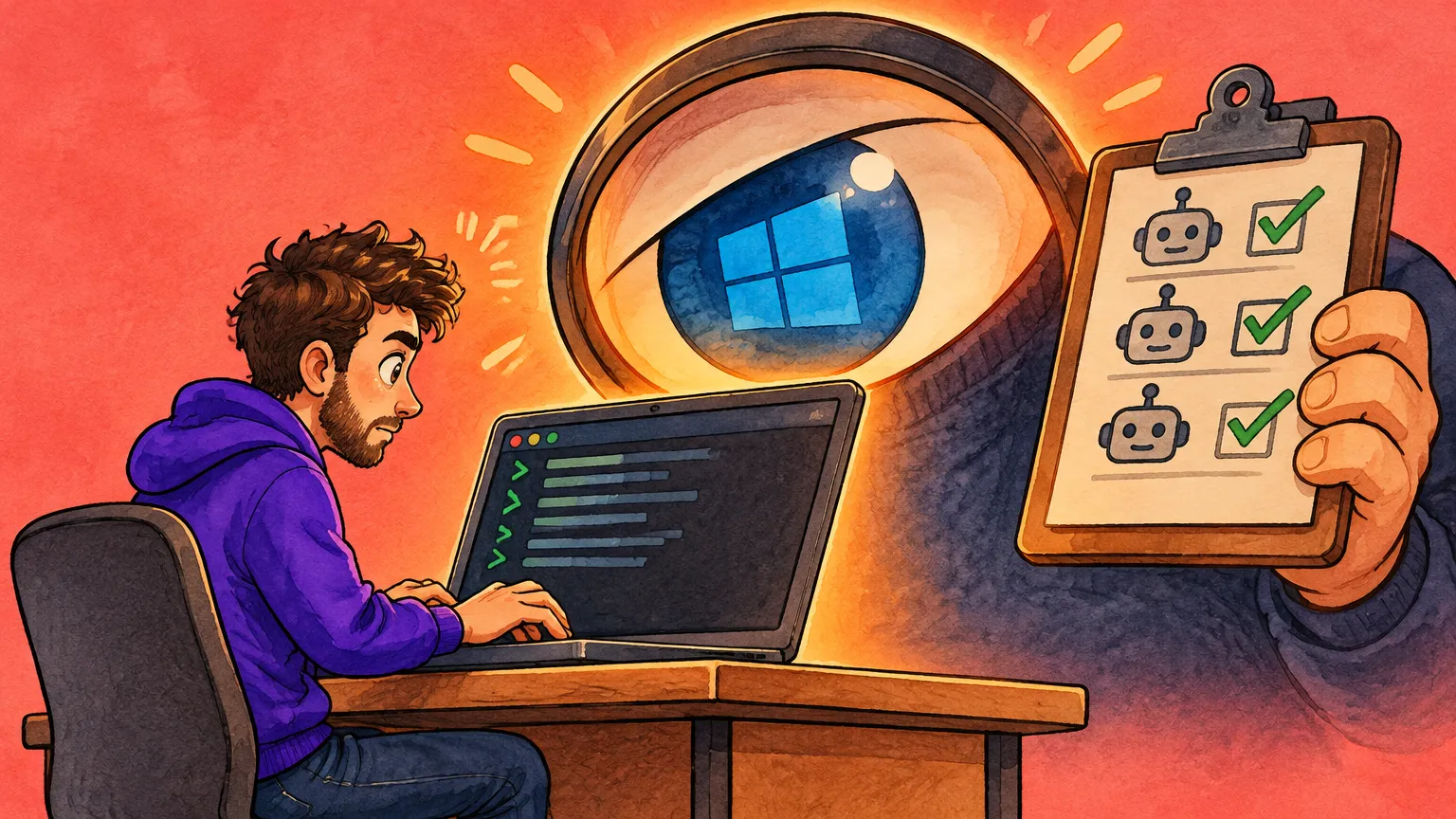
The story: Xusheng Li dug into a Windows 11 file called MissionControlAggregator.dll. It checks running processes against a list of coding agents and dev tools. Each one it sees sets a bit in a report sent through Windows Diagnostics. To prove it, Xusheng renamed cmd.exe to codex.exe, and the DLL counted it.
The details:
- 4 CLI agent slots (Copilot, Claude, Codex, Antigravity) and 5 desktop ones, including Cursor
- Also groups tools like node.exe, python.exe and code.exe into 12 categories
- No prompts or source code in the report, just a bitmap of which tools showed up. State lives under C:\ProgramData\Microsoft\Diagnosis
- 588 points and 422 comments on HN, mostly people pitching Linux
“Optional diagnostic data is therefore enabled by default, at least in the US setup I tested.” (Xusheng Li, xusheng.dev)
Why builders care: Microsoft now measures which agent wins on its OS. Opt out under Settings, Privacy & security, Diagnostics & feedback, and turn off optional diagnostic data.
💳 Optimizely hack put card skimmers on 178 companies’ sites

The story: Attackers wrote malicious JavaScript into Optimizely Web customers’ projects. It shipped from Optimizely’s own CDN to Zoom, GitLab, BBC and HSBC. Scott Helme’s writeup found 188 infected snippets out of 1,611 checked. Nobody knows yet how the attacker got write access.
The details:
- The payload swapped crypto addresses, skimmed card numbers and CVVs, and stole cookies and screenshots
- iPhone visitors also got the Coruna and DarkSword exploit kits
- First injection hit at 04:21 UTC on 16 November; the card skimmer arrived at 13:43, and Optimizely’s files were clean by 23:11
- Of 256 affected hosts, 68 had no CSP and only 24 blocked the payload
“trusted JavaScript doesn’t always remain trustworthy.” (Scott Helme, Report URI)
Why builders care: Every third-party script tag is someone else’s write access to your checkout. Ship a strict script-src and connect-src CSP, even in Report-Only mode first.
🧭 OpenCode Browse gives any MCP agent your logged-in tabs

The story: OpenCode Browse is an MCP server plus a Chromium extension. Your agent drives your real browser, with your logins and extensions. Its tabs open in the background, grouped out of your way. You can also lend an agent a tab you already have open with one toolbar click.
The details:
- Works with Claude Code, Cursor, Codex, Zed and any MCP client
- Hands the tab back for 2FA, logins and payments, then continues
- Lock an agent’s tab to sites you name. It captures screenshots, tab recordings and network traffic
- Source is on GitHub; 246 points on HN
“Security should be enforced outside the harness with a sandbox.” (zaptheimpaler, Hacker News)
Why builders care: Agents can finally test flows behind your Stripe or Google login without API keys. Give them a separate browser profile, not the one holding your bank session.
TRENDING TODAY
🎓 CMU puts CS courses on YouTube: Carnegie Mellon is premiering 8 courses this week, including AI Agents with Daniel Fried and Graham Neubig, and ML in Production. 5 more land in January, and self-paced courseware with AI tutoring is next. It’s free, and it hit 1,477 points on HN.
📮 Spamhaus tightens sender rules: Starting this month, Spamhaus wants every sending IP to have a valid HELO, a PTR record and a matching A record. Bounces stay under 5%, and new domains should wait 30 days before sending. If you self-host your SaaS mail, check your reverse DNS today.
STACK OF THE DAY
🧰 Sure
Sure is the community fork of Maybe Finance, the open-source budgeting app its company walked away from. Net worth, cash flow, rules, and an MCP server so Claude can read your accounts. Free to self-host with Docker; bank sync through Plaid or SimpleFIN is the catch. If you pay Monarch $15 a month and already run a home server, try it this weekend.
Watch our deep dive on YouTube
Not sponsored. We just feature tools builders would actually use.